
What is a Cochlear Implant?
A cochlear implant is an electronic medical device that substitutes for the function of a damaged inner ear (cochlea). Unlike conventional acoustic hearing aids that primarily amplify sound volume, cochlear implants convert acoustic waves into precise electrical impulses and deliver them directly to the auditory nerve, enabling the brain to perceive natural auditory signals.
Who Can Benefit from a Cochlear Implant?
Cochlear implants provide substantial clinical hearing improvement for individuals in the following conditions:
- Individuals experiencing moderate-to-profound bilateral sensorineural hearing loss.
- Patients who receive minimal or no functional benefit from conventional high-powered hearing aids.
- Individuals scoring 50% or less on standardized clinical sentence recognition tests in the ear to be implanted.
- Individuals scoring 60% or less in the non-implanted ear or with bilateral hearing aids during speech discrimination testing.
Bilateral cochlear implantation (implants in both ears) significantly enhances sound localization, speech comprehension in noisy social environments, and spatial hearing awareness.
How Does a Cochlear Implant Work?
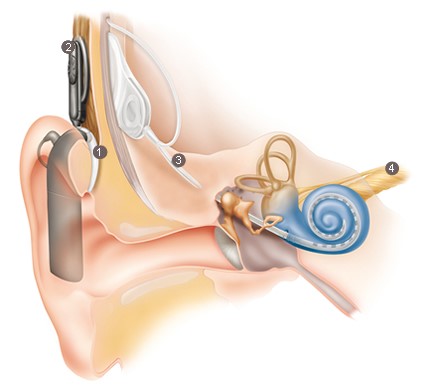
The cochlear implant system captures environmental sound, converts it into digitized codes, and transmits micro-electrical currents directly to the auditory nerve. The brain interprets these neuro-electrical pulses as clear, recognizable sound. The process operates in 4 synchronized stages:
- An external sound processor worn behind the ear captures acoustic sound waves and converts them into high-fidelity digital codes.
- The processor transmits these digital signals across the skin via an external transmitter coil to the internal implant.
- The internal implant converts the digital stream into specialized micro-electrical pulses and directs them through an electrode array situated inside the cochlea.
- The electrode array stimulates the fibers of the auditory nerve, which transmits the impulses to the auditory cortex in the brain where they are perceived as clear speech and sound.
What are the Proven Benefits of Cochlear Implantation?
Adults and pediatric patients undergoing cochlear implantation routinely achieve outstanding improvements:
- Significantly clearer hearing than acoustic aids: Clinical studies demonstrate average sentence comprehension reaching up to 80% or higher.
- Enhanced speech clarity in noisy settings: Ease of following conversations in restaurants, conference meetings, and crowded social gatherings.
- Rediscovering subtle natural environmental sounds that were previously imperceptible (birdsongs, flowing water, doorbells, nature).
- Heightened personal safety and confidence through the ability to perceive approaching vehicles, traffic alerts, and emergency sirens.
- Comfortable telephone communication and enriched music enjoyment.
Key Factors Influencing Treatment Success
Auditory outcomes may vary according to individual patient characteristics. Key determinants include:
- The duration and progression of hearing deprivation prior to implantation.
- The baseline anatomical integrity of the inner ear (cochlea) and auditory nerve fibers.
- Dedicated adherence to post-operative audiological fitting sessions and speech therapy rehabilitation.